

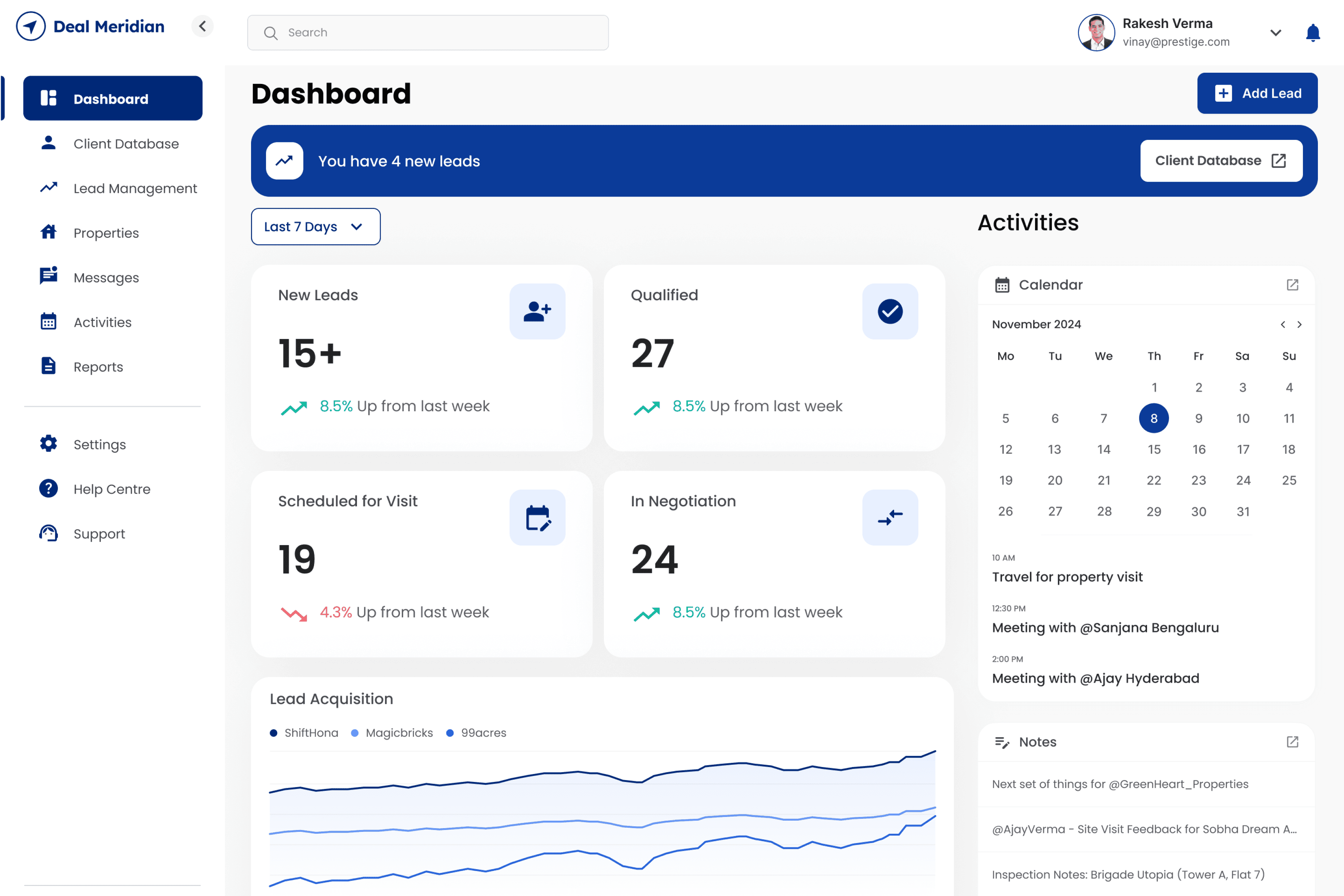

As part of my Master’s program, I worked on an industry-sponsored project with Deal Meridian, a New York based Property Tech company building AI-powered relationship management tools. The project began with a simple observation that across Indian cities, property brokers were running their entire businesses across WhatsApp threads, Excel sheets, listing portals, phone calls, and handwritten notes. Every broker had their own way of keeping track of clients. None of it lived in one place.
At first, this patchwork system seemed to work. Brokers remembered who wanted what. They knew who needed a call back, who was still deciding, and who might be ready next month. But as client lists grew, so did the mental load. Details slipped. Follow-ups were missed. Conversations quietly lost continuity — not because brokers were careless, but because too much of their work lived inside memory.
It quickly became clear that this wasn’t an isolated issue. Across brokerage communities, the same pattern kept surfacing: fragmented tools, scattered context, and no system that truly supports how brokers think, remember, and build relationships.
“Wouldn’t it be great,” brokers asked, “to have one place that actually remembers our clients the way we do?”
❝
❞
Interviews and ground reality
We wanted to understand how real estate actually works on the ground. Our research focused on three sides of the ecosystem: renters and buyers, brokers, and property sellers. We studied how people discover properties, what steps they follow to make decisions, and where friction and uncertainty enter the process. We looked closely at how brokers manage leads, track conversations, and coordinate across multiple tools, and how sellers list, update, and communicate about their properties. Across all three groups, our goal was to surface where workflows break, where context gets lost, and what makes coordination between people slow, fragile, or inefficient.
From what the stakeholders told us, we understood that
Renters juggle multiple platforms, but no single place preserves context or continuity.
Outdated and inaccurate information forces renters to rely on brokers and personal references.
Search lacks personalization and turns decision-making into a slow, frustrating process.
Inefficient coordination creates delays, missed follow-ups, and unnecessary friction.